by Susan Dean | Feb 6, 2018 | Animals, Land Animals

Recently a friend showed me a hickory horned devil caterpillar, a monstrous caterpillar and the scariest I had ever seen. The Regal Moth or Hickory Horned Devils are commonly found on walnut, hickories, persimmon, sweetgum, and sumacs. It’s said that larvae grow faster and larger on persimmon.
The moth lays up to four tiny yellowish eggs on the upper surface of the host plant that hatch 7–10 days later. After hatching, the small black larva feeds at night and sleeps the day, using leaf tops as hammocks and masquerading as a bird dropping. The larva molts four times, enlarging with each molt and changing colors, wearing shades of yellow, brown, and bright orange before the final coat of green. It spends about forty summer days devouring foliage.
The larva, mistaken for bird poop, mushrooms into the largest North American caterpillar at six inches long and fat as a hot dog with a massive reddish-orange headpiece of horns with black spikes up to an inch long. Enhancing fear are two long and two shorter red spikes protruding from the next two segments, and four short black spikes on the abdominal segments. Big black spots on the body mimic eyes. Chickens shy away, but other birds devour them. Pick them up without fear, but picking them up is the hardest part.
The caterpillar’s spikes neither pierce nor sting; its bright colors are just for show; and its ruse of rearing its horned head and vibrating violently to create a buzz resembling that of a rattlesnake’s is but a scam.
Before pupation, the larva expels its gut and changes color from green to turquoise. They crawl down the host and burrow in the ground five or six inches deep and pupate in a earthen chamber, rather than spinning a cocoon. The devils are transfigured into glossy brown pupae, which will spend winter entombed like mummies. Some pupae overwinter two seasons.
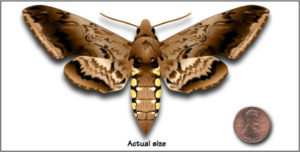
From the tomb arises the adult regal moth, giant cousin of the silk moth and the largest moth north of Mexico. When the orange veined, greenish-gray wings dotted with creamy yellow are smoothed open, they measure up to six inches across. After mating, the female spends her life laying eggs. Adults have vestigal mouths, mouthparts are reduced, and they do not eat and only live about a week. It’s a midsummer moth, on the wing from late June through August with larvae peaking August through October. Remember, they may look creepy, but they’ve got nothing.


by Susan Dean | Feb 6, 2018 | Animals, Land Animals

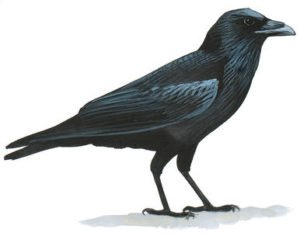
Something about these corvids seems almost spooky, making them the unofficial mascots of Halloween. Flocks of them aren’t called an “unkindness of ravens” or a “murder of crows” for nothing. Can you tell the difference in ravens and crows?
Common Ravens and American Crows overlap widely throughout North America, and look quite similar. Ravens are larger, the size of a Red-tailed Hawk, and often travel in pairs. Crows are seen in larger groups. Watch the bird’s tail as it flies overhead. The crow’s tail feathers are mostly the same length, so when it spreads its tail, it opens like a fan. Ravens have longer middle feathers in their tails, so their tail appears wedge-shaped.
Crows give a cawing sound. Ravens produce a lower croaking sound. While crows caw and purr, ravens croak and scream bloody murder.
A raven’s strut is often punctuated by a few two-footed hopping flights. Ravens ride the thermals and soar and crows do more flapping. Ravens have bigger, curvier beaks relative to crows. While both species have bristles at the base of the beak, the raven’s are noticeably longer. Its throat feathers are quite shaggy. Look for ravens foraging in pairs; crows are highly sociable and will hang out in murders and communal roosts.
THE CROW


by Susan Dean | Feb 6, 2018 | Gardening, Plants

Potatoes
Throughout history, they’ve been maligned as food fit only for animals and revered as “apples of life.” These vegetables kept Incan civilizations thriving, helped fuel the Industrial Revolution, triggered mass population shifts, and are now one of the world’s four most important food corps. They are used to produce paper, adhesive, biodegradable plastics, and even cosmetics. Potatoes can provide an exciting focus for scientific investigations, nutritional lessons, and for exploring world cultures and history.
Classroom gardeners don’t have to be a bunch of couch potatoes. Have each student bring in a potato, then have pairs or small groups of students observe the tubers, writing down all of the observations they can make as well as things they know about potatoes. Make a class chart with the headings: Things We Know About Potatoes and Things We’d Like to Know. At the end of your potato adventures add columns What We Learned and Questions we Still Have. Refer to the chart throughout your potato study andat the end to assess what students have gained.
Students should discover that it has numerous small indentations or “eyes” (and even eyebrows!). These are the beginnings of tiny buds that, with the right conditions, will produce sprouts. Farmers and gardeners plant pieces of potatoes with eyes (called “seed potatoes”) instead of growing potatoes from actual seeds. When a piece of potato is planted, the starch in this seed piece “feeds” the plant until it’s leaves are mature enough to photosynthesize and produce their own nutrients. The nutrients in the seed piece are used up in the process.
Take a wide mouthed jar and using a few toothpicks inserted around the potato, sit the potato on top of the jar so that a portion of the potato in the water. Place it in a window. You’ll find stems and leaves emerging from the potato sprout and thread-like roots growing from their base. Compound potato leaves (made-up of small leaflets) will eventually be arranged around the stem in a spiral pattern, an adaptation to ensure that each leaf receives as much sun as possible.
Potato plants have underground stem extensions called rhizomes. Once the plant has finished its initial phase of growth, the leaves make more carbohydrates than is necessary for plant growth. The extra is stored as starch in the rhizomes. As this starch builds up, the tips swell into the tubers we call potatoes. Though potato plants produce flowers, seeds and small fruits, these are not part of our diet. Compare potato flowers with those of their relatives-tomatoes, eggplant, peppers, petunias, and tobacco and see if you notice a family resemblance!
Ancestors of the Incas living high in the Andes in South America more than 6,000 years ago are believed to have stumbled on many types of small, bitter wild potatoes that survived well in the harsh mountain climate. These early farmers developed sophisticated growing methods, allowing them to cultivate huge quantities of potatoes. To keep their precious harvest from spoiling, they spread potatoes on the ground until they froze overnight, then walked on the potatoes the following day to squeeze out the water. After letting them dry in the sun and repeating this for several days, they had a dried powder called chuno, the first freeze-dried product!
When Spanish explorers came to Peru in the 1500s looking for gold and silver, they paid little attention to these homely tubers, and the few potatoes that they did take back to Europe were not an immediate hit. People were skeptical since this strange new food grew underground. It didn’t help matters when Queen Elizabeth’s cooks threw out tubers and cooked the leaves and stems making the royal guests ill! Potatoes were at times considered as peasant food barely fit for human consumption and at other times reserved as a delicacy for the wealthy class! Easy to grow in many climates and soils, potatoes had by the mid-1800s become one of Europe’s most important foods. The poor masses finally had a crop that was easy to grow and process, was very nutritious, and could be raised on small plots. Nourished on potatoes, more children survived than were needed to help on farms and as more people moved to cities to work in factories the Industrial Revolution thrived.
Take away the extra fat and deep-frying, and a baked potato is an exceptionally healthful low calorie, high fiber food that offers significant protection against cardiovascular disease and cancer. Our food ranking system qualified potatoes as a good source of vitamin B6, vitamin C, copper, potassium, manganese, and dietary fiber. Sixty different kinds of phytochemicals and vitamins are in the skins and flesh of 100 wild and commercially grown potatoes. Analysis of Red and Norkotah potatoes revealed that these spuds’ phenolic content rivals that of broccoli, spinach and Brussels sprouts, and includes flavonoids with protective activity against cardiovascular disease, respiratory problems and certain cancers. Potatoes have been identified with high levels of vitamin C, folic acid, quercetin and kukoamines. These last compounds, which have blood pressure lowering potential, have only been found in one other plant, Lycium chinense (a.k.a., wolfberry/gogi berry).
Potatoes also contain a variety of phytonutrients that have antioxidant activity. Among these important health-promoting compounds are carotenoids, flavonoids, and caffeic acid, as well as unique tuber storage proteins, such as patatin, which exhibit activity against free radicals.
Nutrients inPotatoes 1.00 each baked (173.00 grams)
vitamin C 27.6% vitamin B 627%
potassium 26.4% tryptophan 21.8%
manganese 19% fiber 15.2%
Calories (160)8%
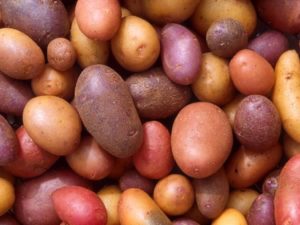
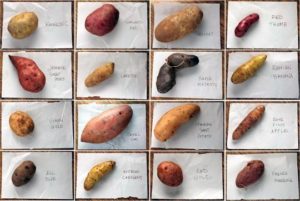
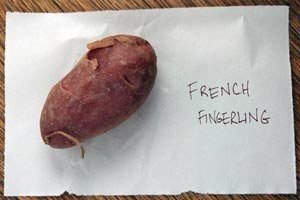
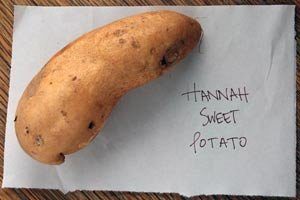
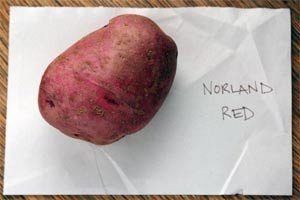
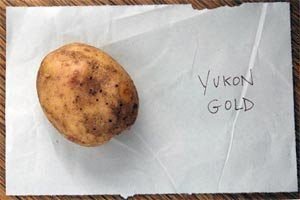
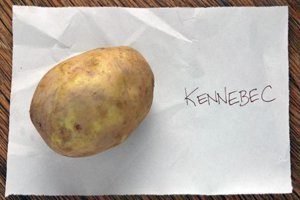
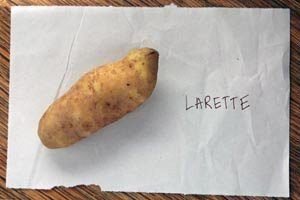
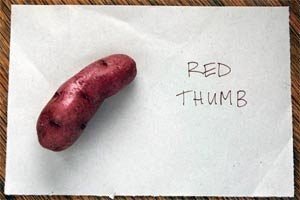
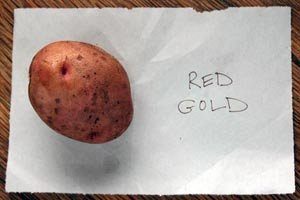
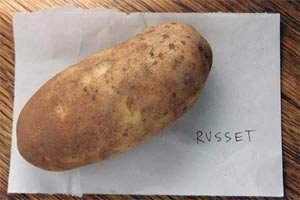
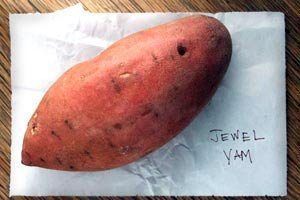
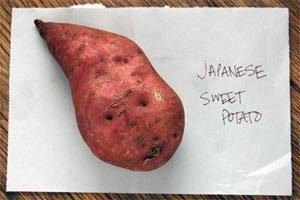
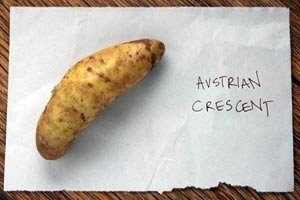
SOOO MANY KINDS OF POTATOES!


by Susan Dean | Feb 6, 2018 | Gardening, Plants

Hairy vine – No friend of mine!


Poison Ivy and Poison Oak
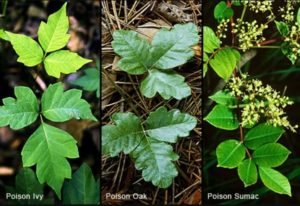
Nothing takes the fun out of being outdoors faster than an encounter with poison ivy. It regenerates readily, is everywhere, and people loathe it. All are perennials in the cashew family, and all cause a rash, blisters, and itch. “Leaves of three, let them be” is still the best way to identify poison ivy and poison oak. Poison ivy’s leaves are pointed. Poison oak’s leaflets are rounded. Poison Ivy’s “leaves of three” are glossy-green, but are tinged with pink in the spring, and take on a brilliant orange in the autumn. It has small, pearl-colored berries that are a favorite treat of many birds, which spread poison ivy seeds around the countryside.
The poison is an oily resin called urushiol that occupies every part of the plant, including the roots. The leaves, especially young ones, contain the most toxins. The oil can remain on tool handles and clothing for as long as a year. Dogs and cats can carry its potency on their fur. This is why you can come down with a rash without having seen poison ivy in months. Fortunately, the oils don’t always go to work immediately, especially on dirty or work-hardened hands.
Both poison ivy and poison oak grow in sun or shade, in wet or dry places, and turn vivid colors in fall. The berries are white and are a good identifier once the leaves have fallen off in early winter. Poison ivy can grow as a groundcover, a shrub, or a vine. Emerging leaves have a red tint to their edges. It grows as a vine or shrub. Both poison ivy and poison oak climb trees, sending out thick, hairy, aerial roots. Virginia creeper is often mistaken for poison ivy, but Virginia creeper has five leaflets, and blue-black berries.
Protect Yourself – If you come in contact with poison ivy, wash at once and launder your clothes using old yellow laundry soap or borax to cut the oil. (Soaps made with fat are ineffective.) For mild cases use calamine lotion, over-the-counter cortisone creams, and saltwater soaks, but severe cases require prescription cortisone. A barrier cream, IvyBlock, containing quaternium-18 bentonite, which bonds with the urushiol, promises to be effective 68%of the time, if applied before any contact with poison ivy.
Wear long sleeves, pants, closed shoes, thick gloves, and even a mask when removing poison ivy and poison oak. Ivy Block is an FDA-approved lotion that, when applied before exposure, prevents skin that comes in contact with urushiol from developing the rash. It’s available at drugstores.
Wash all clothes, even shoelaces (without touching them with your bare hands), after working near poison ivy and poison oak. Use hot water, detergent, and two wash cycles.
Wipe down any surface that has come in contact with the oil (tool handles, doorknobs, shoes, etc.).
Wash it away. Do not wipe with water. Urushiol is an oil. Rinse the affected skin with isopropyl (rubbing) alcohol, then with cold water. Don’t wipe. Wiping spreads the oil.
Burt’s Bees Poison Ivy Soap and Res-Q Ointment also remove the oil and relieve itching. Without treatment, the infected area will blister within a few hours to three days. The fluid in the blisters will not spread the rash, but any clothing that has come into contact with the oil will. Oral antihistamines can help, if needed.
Poison ivy and poison oak spread by seed and by their vigorous root systems. Birds eat the berries and deposit the seeds. If you have wooded or neglected areas surrounding your property, you probably have poison ivy as a neighbor, and given time, it will creep into your yard. Plants can be destroyed by covering them with black plastic or spraying them with the appropriate herbicides, but beware—even dead plants are infectious.
Five ways to beat this foe into submission:
1. Keep it out. Prevent poison ivy or poison oak from taking hold in the first place. If you are landscaping or tilling soil for a new bed or garden, don’t leave the ground bare for long.
2. Small infestations are more easily controlled than larger ones, because they have less-developed root systems, fewer stored food reserves in roots and rhizomes, and a smaller seed bank in the soil. Poison ivy can be readily pulled in early spring if only a few plants are involved.
3. Cut it off. As with all perennials, you must completely remove the root or the plant will resprout. Unfortunately, poison ivy roots can run underground for many feet before the plant reappears above ground. If endless digging is not appealing or an option, repeatedly cutting the plant to the ground eventually starves the root system and causes the plant to die. Plants climbing trees should be severed at the base. Don’t bother removing the vines from the tree; they don’t do any harm. The weed is just using the tree for anchorage. It’s not a parasitic relation- ship.
4. Smother it. Cover the infested area with thick black plastic sheeting, and plan to leave it there for at least a year, possibly longer. Make sure the plastic isn’t the type that degrades in the sun, and cover the edges with dirt to exclude all light.
5. Chew it up. Grazing animals, especially goats, are not bothered by urushiol and can clean up an infested area. They won’t take out the root system but will get rid of the top growth, weakening the plant overall.
Dispose of poison ivy and poison oak in plastic bags and put them out with the trash. The easiest way to do this is to put the plastic bags over your gloved hands, pull the plants into the bags, and then pull the bags inside out off your gloved hands, encasing the poison ivy inside the bag. Be nice to your garbage man and put the poison-ivy-filled bags into a larger, uncontaminated bag.
Don’t compost it. Urushiol remains potent for years—even, in dry climates, decades.
Never burn it. Breathing in smoke or soot from the plants may cause serious inflammation of respiratory mucous membranes.
Other Itchy plants are:
Myrtle spurge, or donkey tail has toxic, milky latex that can scar the skin.
Rue contains a photochemical in all parts of the plant that causes a heightened reaction to sunlight.
Spotted knapweed causes hives with repeated exposure.
The sap from the century plant will burn your skin.
Wild parsnip has a juice found in the leaves, stems, and fruits that causes photosensitization.

























 You may see a hornworm with white egg-like structures on its back. These are the pupae of very small parasitic wasps less than 1/8 inch long, black with yellowish legs and clear wings. The female wasp uses her ovipositor to lay eggs just under the skin of an unlucky hornworm If you see a bright green hornworm carrying what looks like a clutch of white-colored insect eggs on its back, leave it there! As the eggs hatch, the larvae feed on the hornworm. This wasp is a friend to the home gardener! They like to feed on things we don’t like in our gardens: hornworms, caterpillars, beetles, aphids, squash bugs and stinkbugs.