by Susan Dean | Feb 5, 2018 | Animals, The Human Body

Show children the chart of the food pyramid and ask them the shape of it. Ask them to see the largest part of the pyramid at the bottom. Ask children if they eat grass. Do they eat pasta?
SEEDS FEED THE WORLD.
Hold the ear of corn up and ask them what part of the plant it is; root, stem, leaf, flower, fruit, or seed?
Teach them the song (with rhythm and movements) about the six parts of a plant.
Tell a story about corn. When we pick corn fresh from the plant it is young and tender and delicious, but if we let it stay on the plant it becomes hard and matures into seeds. We can take a seed that looks very dead and plant it in the ground and if the seeds needs are met, it will grow a new corn plant! We can pop the seeds into popcorn, grind them up into grits, or cornmeal to make hushpuppies, muffins or cornbread or grind them fine to make cornflower for tortillas. Let children see a sample of bread and notice that it has holes in it from a gas that forms and makes the bread rise when it is baked They can eat it too!). All kids love bread. You know they say bread is the staff of life.
Pretend to make cornbread and put some cornflower in a bowl, add egg, some milk and a secret ingredient that makes air and the batter rises when it is baked. Show them what happens by doing the experiment creating a gas (Co2) from a solid (baking soda) and a liquid (vinegar). Pour some vinegar in a clear soda bottle. Fill the balloon with some baking soda using a funnel. Show children the funnel and tell them it is used to make a little mouth into a big mouth. Attach the rim of a balloon to the bottle and lift it to let the soda fall making a gas that blows up the balloon.
Materials: Chart of the Food Pyramid, ear of corn, samples of grains (from feed store wheat, barley, oats, rye, rice, corn) Samples of things we make from grains (cereal, popcorn, grits, cornmeal, cornflower, bread, and cookies.) 1 soda bottle, baking powder, funnel, vinegar, and balloon.
Activities: Examine grains from grasses. We make flour, bread, pasta, and cereals from them. Do rhythm exercise and teach the song about plant parts. Give each child a slice of bread to examine the holes in it. Then do the experiment making the reaction of vinegar and soda blow up the balloon. This is what happens when we bake bread, filling it with holes from the air created. Children can plant seeds of grains and with care, see them grow!
by Susan Dean | Feb 5, 2018 | Animals, The Human Body

Content: Plants on Our Plate: Fruits and Vegetbles
Have you been tired and felt like you didn’t have any energy? How do we get energy?
1. OXYGEN from the air we breathe.
2. FOOD we eat gives us energy and nutrients to grow and build a healthy body.
3. EXERCISE to keep systems flowing and strengthen them.
4. REST for the brain to gather chemicals needed for the next day.
Do you eat plants; roots, stems, leaves, seeds? (Many young children will respond no!) We eat all the parts of plants. Remind them about the energizing grains, the group of foods like rice, corn, pasta, bread. Two other food groups good for you to eat are vegetables and fruits. Are plants alive? Yes plants are alive and go from seed to seed growing and multiplying. They breathe; need sun to live, water to drink, and vitamins and minerals from the soil to grow strong. Plants turn the light of the sun to energy! You don’t see plants going to the grocery store for food. Their leaves make their food from sunlight through a process we call photosynthesis. Plants are producers and they feed the planet!
What are the parts of a plant? Say after me; roots, stems, leaves, flowers, fruits, and seeds. Teach children the song about the 6 plant parts. Hold up a vegetable or fruit and let the children tell if it is a fruit or vegetable. Ask what part of the plant is it and let them say if it grows on a tree, vine, or bush. Make up puzzles for the children such as: What is white inside, grows on a tree and can be red, yellow, or green? (apples) What is the difference in processed and unprocessed food? Which is better for you? Fresh raw or steamed vegetables and fruits are best to eat. Ask children to name some of the fruits and vegetables grown in S.C. We get many vitamins and minerals from fruits and vegetables that help our whole body grow strong and healthy.
Activities Show some energy by doing some stretching and energizing exercises. Hand out samples of fruits and vegetables(artificial samples) and let them tell what part of the plant it is and what kind of plant it grows on (vine, bush, or tree) Solve food puzzles. Ex. It is a root and is the color orange. What is it? Children learn the songs “I am a Sprout” and “Six Plant Parts”
Materials: Food Pyramid chart, samples of fruits and vegetables; coconut, broccoli, carrot, potato, celery, apple, leaves. These represent the different parts of a plant.
Books to read: Where Food Comes From by David Suzuki and Barbara Hehner, Growing Vegetable Soup by Lois Elhert
by Susan Dean | Feb 5, 2018 | Plants

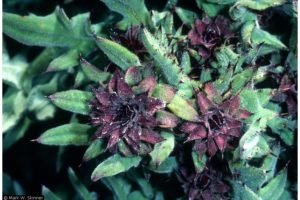
Fountain Thistle
Plants Summary
There are thousands of kinds of plants. Plants are producers and provide food and shelter for many animals. The basic structures of a plant are the roots, stem or trunk, and crown which usually includes the leaves, flowers, fruits and seeds
Though some plants are parasites and live off of other plants, most plants make their own food. The leaves are the food factories. Chlorophyll is the magical substance that gives them their green color and allows them to make their food from sunlight. Using sunlight for energy and H2O and CO2 they make the sugar glucose. 6 CO2 + 6 H2O + light energy = C6 H12 O6(sugar) + 6O2. The long chains of sugar molecules form the cellulose of plants. Another interesting thing is that if you are in the hospital and in need of nutritional strength they give you glucose.
Plants must have sunlight, water, CO2 from the air and nutrition to survive. They transpire through the little stoma located on the underside of leaves. These look like two little lips that open and close by shrinking or swelling. A plant will wilt or die if it doesn’t get enough water. Some will rot if they get too much water. They are as picky and individual as people!
Some plants like hot, some like cold. Some like it dry, some like it wet.
Some like shade, some like it sunny. Some are soft, some are hard.
Some are furry, some are thorny. Some are tiny, and some are huge.
Plants move! They may climb, crawl, float, or stand. Tropisms are the movement of plants in response to an external directional stimuli. Geotropism is a response to the force of gravity. Phototropism is when a plant moves towards light. Hydrotropism is when the roots of a plant move towards water. Roots are generally positively geotropic and grow downward. The roots are the sponges that soak up water and anchor the plant. Tropisms are controlled by differences in concentrations of growth hormones.
Some plants have leaves or flowers that open and close. In the mountains when the weather gets very cold rhododendron leaves will curl up. The sensitive plant closes it’s leaves if touched. Some flowers open and close at specific times like the morning glory, four o’clock, dandelion, or daylily. You might have students make a flower clock. Some flowers only bloom at night like the moonflower.
Plants cells have a cell wall that is lacking in animal cells. The wall gives the plant strength and support.
Plants come in a variety of sizes and colors. They may be white, orange, purple or many other colors. They grow from the soil, on bread, cheese, rocks, on other plants, in the ocean, lakes, deserts, and swamps. There are plants that look like animals and plants that look like stones. There are plants that live in trees like mistletoe, orchids, and Spanish moss. There are plants that climb like ivy, honeysuckle, grapevines, pumpkins, cucumbers, and morning glories.
Algae include some of the simplest plants know to man. They are mostly aquatic and range in size from one single cell living on trees, in snow, ponds and the surface waters of the ocean to strands of cells several meters long that make up seaweeds in the deep ocean. Algae in marine and freshwater plankton are important as the basis of food chains.
There are plants that act like animals. From spores slime mold crawls like a worm then becomes fixed like a stem. Some plants eat insects like the sundew, Venus flytrap, and pitcher plant. There is a fungus that catches worms with a lasso. My favorite is the microscopic euglena that has chlorophyll and can make it’s own food but moves and eats like an animal as well. Lichens are two plants that are partners. One makes food and the other finds water. They may grow on bare rock and break rock down to soil.
The leaves of deciduous plants change colors in the fall because cork forms in the stem of the leaf and cuts off the water supply. When there is no water the chlorophyll green fades. Carotenes and anthocyanins in the leaves give other colors. If sugar is trapped then the color turns red or purple. Leaves turn brown when dry and are dead. Galls in the leaves or stems of plants are bumps where insects have laid eggs. When a leaf falls from a plant it leaves a scar. Many of these scars look like cute little faces. The scar left by a leaf from the Tree of Heaven is the shape of a heart!
Some plants are poisonous or have poisonous parts such as poison oak and ivy, mistletoe, castor bean, yew, oleander, poinsettia, mountain laurel, wild cherry, and rhubarb
Plants may be evergreen or deciduous. Evergreens don’t freeze in winter and their leaves are tough and they remain on the plant through the winter. Deciduous plants lose their leaves in the fall.
Plant Biomes:
Pond – cattails, lilies, lotus, duckweed, algae, bulrush, calamus
Ocean – seaweed, kelp, diatoms, eelgrass, sea lettuce, sargassum
Desert – cactus, yucca, stone plant
Rainforests are tropical and plants are green all the time.
Mountains have many biomes
Plants may partner with other life; the indian pipe plant partners with a fungus, the monarch butterfly partners with milkweed.
Plants give us food (seeds feed the world), medicine, spices, drinks, clothing, jewelry, dyes and many more things than I can mention. I love plants!
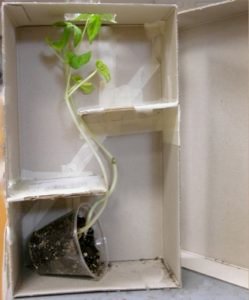
EASY PHOTOTROPISM EXPERIMENT WITH KIDS
by Susan Dean | Feb 5, 2018 | Plants

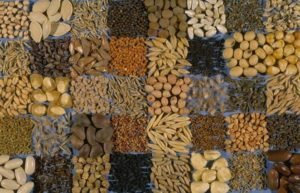
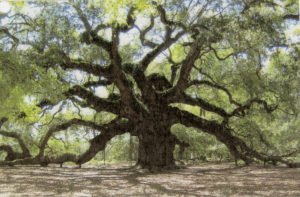
Plants are the oldest and largest form of life on Earth(trees). Ask kids if they eat leaves, roots, stem, or seeds. You will be surprised at their answers. Yes, we eat all plants parts. There are six basic parts to a plant: root, stem, leaf, flower, fruit, and seed. Teach the song about plant parts. Seeds feed the world. Do you eat grass? Grains such as corn, rice, cereals, breads, and pasta are made from the seeds of grasses. Seeds travel on the wind, through a stomach, on animals or across the ocean and each kind of plant seed looks differently. Flowers make the seeds. Use the felt board to show the parts of a flower: sepals, petals, Stamen, pistil, sticky stigma, pollen, ovules. When a seed gets the right amount of water and sunshine and if it is in the right place, the seed will germinate and sprout and a new plant begins to grow. Plants need water, soil, and sunshine to grow. Ask them if they see plants going to the grocery for food. Leaves are the food factories of plants and through a process called photosynthesis they turn sunlight into the sugar glucose. Plants make their own food! On the bottom side of leaves their are the stoma that look like little lips. These open and close allowing the plant to breathe.
Materials: hand drum for music, paper and pencils for drawing the parts of a flower. Samples of many different kinds of seeds for them to examine. lima beans, paper towels, baggies, Felt board of parts of a flower. Pots of soil and seeds.
Activities: Learn song about the parts of a plant and “I am a Sprout”. Examine different kinds of seeds. Make a felt board flower showing the parts or a felt board plant showing the parts of a plant. You can also draw it on a wipe off board. Dissect flowers. Wrap 3 lima beans in a wet paper towel and seal in a plastic snack bag to germinate. Plant some seeds in seed pots.
Happy faces in the cross-section of a blade of grass. Aren’t natures designs amazing!
Such Beautiful Stems

Phototropism

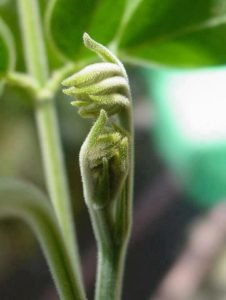
Leaves unfolding

by Susan Dean | Feb 5, 2018 | Plants
The Skill of Classification
At its simplest, classifying means organizing objects by their similar or dissimilar characteristics. The process of classifying helps children obtain information about the world around them, as well as developing thinking and reasoning abilities.
Classifying can start as early as toddlerhood, when a child might put all the blue blocks, red blocks, and yellow blocks in their respective piles. They might not even know the word for each color yet, but they can observe the differences between them.
“One of these things is not like the other”, goes the famous Sesame Street song, and children are extremely adept at picking out things that just don’t fit. Think about what they have to do to figure out these kinds of puzzles: first, they must decide what universal attribute the majority of the items share, and then they must decide which item doesn’t fit the pattern. It’s a two-step process.
Classification becomes more sophisticated when children begin to notice that items can share some attributes but differ in others. For instance, buttons could be sorted by color or shape. Regrouping a collection of objects can strengthen a child’s ability to closely observe and organize according to specific characteristics.
Younger children are usually focused on very obvious characteristics, like color, size, and shape. Examples of these activities include button or bead sorting; small, medium, and large; and shape sorters where only the correct shape will fit through each hole. More advanced classification work includes living/non-living, land/air/water, and fruit/vegetable.
An older child will begin to look at objects with more discrimination: they may notice that while oranges, lemons, and limes are different in color, they are all citrus fruits. Or they may realize that insects, while varying widely in appearance, all have three body parts and six legs. Montessori for Everyone